In my last full day in Israel this past summer, I made my way out into the city on my own for the first time. In the heat of the day I felt the sweat beginning to drip off my face as I made my way around Mount Zion to the southern side of the Old City of Jerusalem— hoping that I had gotten my directions right and would make it to the destination I had in mind.
Finally, I arrived. I walked into the beautiful church, ornate and solemn. As I made my way further in, I found myself descending—the oppressive summer heat growing more distant. Finally I rounded a corner and realized that I was descending into a pit. Cold hard stone surrounded me on all sides, without another soul in sight. And it was quiet—more quiet than I’d ever experienced in the city before.
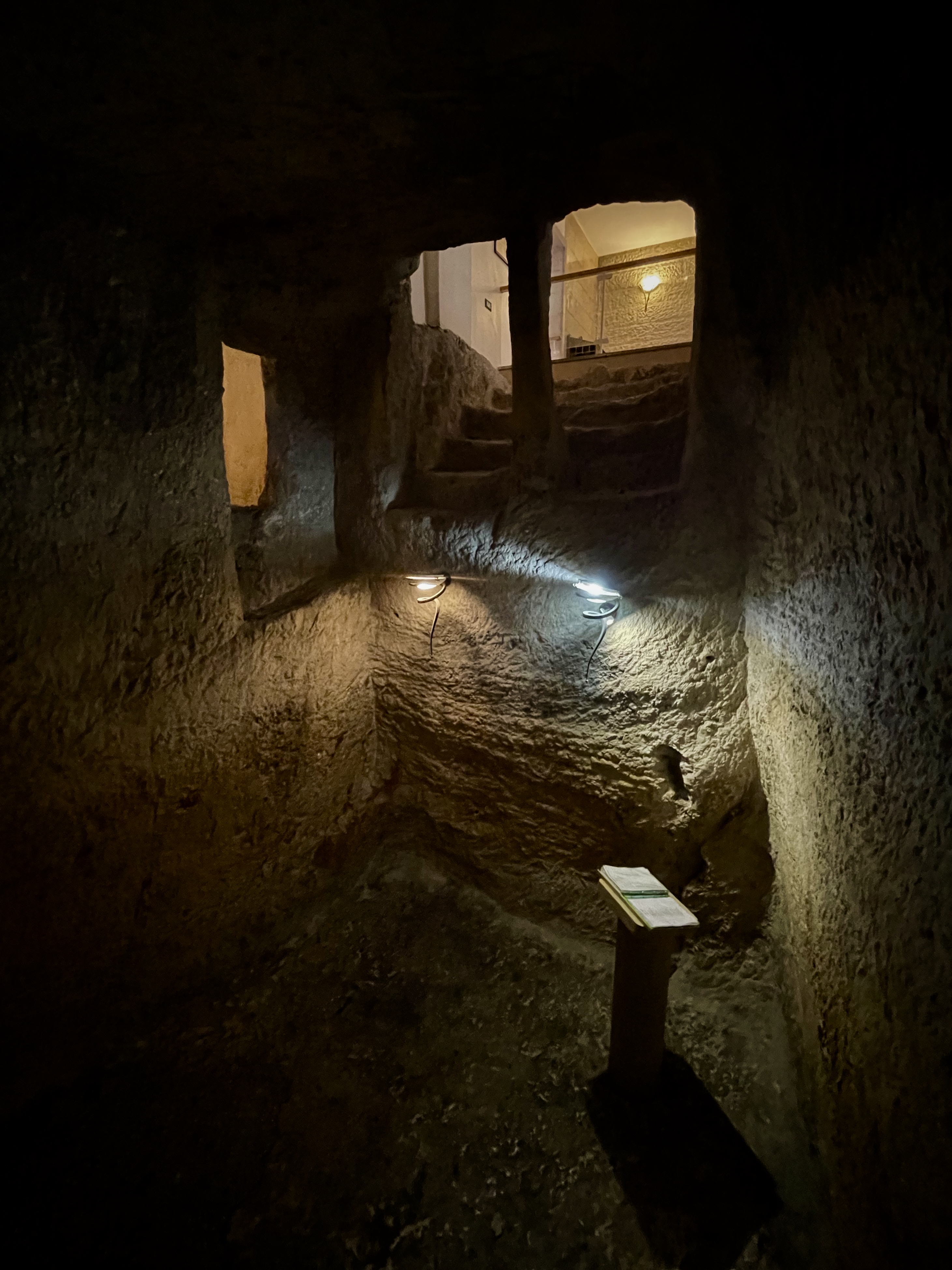
It’s a place referred to as “the sacred pit,” housed inside the church of Saint Peter in Gallicantu—which is thought to be the possible location of the house of Caiaphas, the high priest. In Luke 22:54 we are told that after His arrest in the Garden of Gethsemane, Jesus is brought to the house of the high priest where He spends the night under guard awaiting His trial before the chief priests and teachers of the law. Tradition holds that Jesus would have been held in the pits and caves below the High Priest’s house that would have served as a sort of prison.
I will leave it to others who are much more knowledgeable than myself to judge the historical reliability of this tradition.
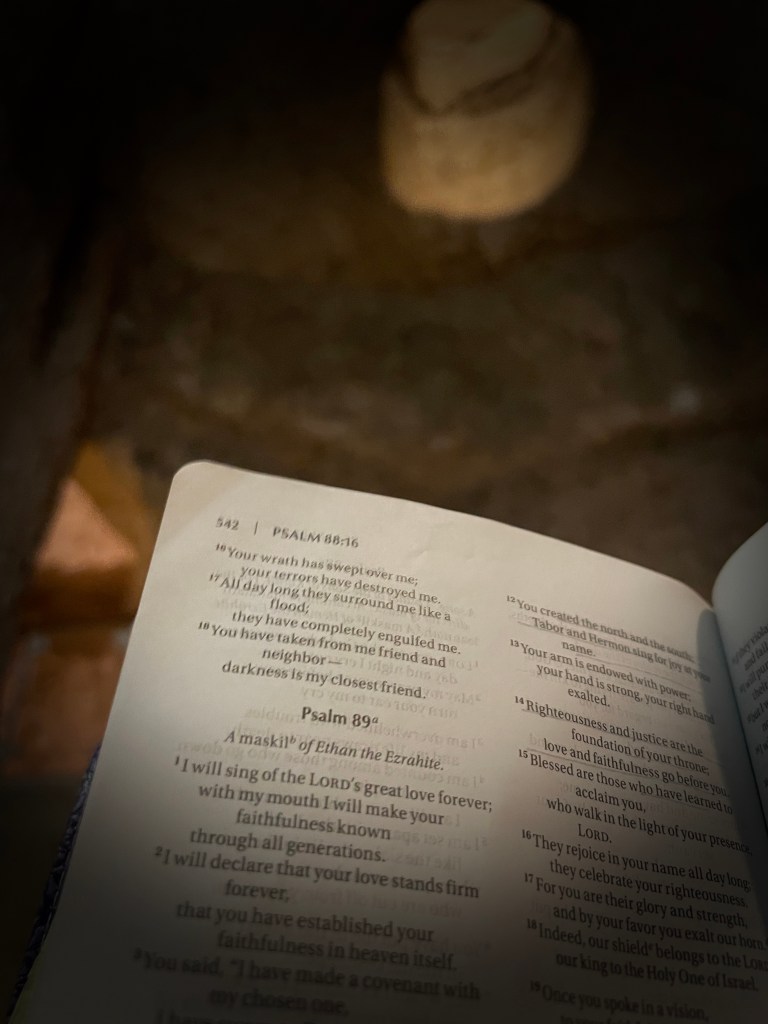
But regardless of whether or not Jesus really did spend the night in this particular pit, the space provides a powerful opportunity to reflect on the hours between Jesus’ arrest and His eventual trial and crucifixion.
Visitors to this space are encouraged to reflect on Psalm 88 in light of Jesus’ experience.
“Lord, you are the God who saves me;
day and night I cry out to you.
May my prayer come before you;
Turn your ear to my cry.
I am overwhelmed with troubles
And my life draws near to death.
I am counted among those who go down to the pit;
I am like one without strength.
I am set apart with the dead,
Like the slain who lie in the grave,
Whom you remember no more,
Who are cut off from your care.
You have put me in the lowest pit,
In the darkest depths.
Your wrath lies heavily on me;
You have overwhelmed me with all your waves.
You have taken from me my closest friends
And have made me repulsive to them.
I am confined and cannot escape;
My eyes are dim with grief.
I call to you, Lord, every day;
I spread out my hands to you.
Do you show your wonders to the dead?
Do their spirits rise up and praise you?
Is your love declared in the grave,
Your faithfulness in Destruction?
Are your wonders known in the place of darkness,
Or your righteous deeds in the land of oblivion?
But I cry to you for help, LORD;
In the morning my prayer comes before you.
Why, LORD, do you reject me
And hide your face from me?
From my youth I have suffered and been close to death;
I have borne your terrors and am in despair.
Your wrath has swept over me;
Your terrors have destroyed me.
All day long they surround me like a flood;
They have completely engulfed me.
You have taken from me friend and neighbor—
Darkness is my closest friend.”
We don’t know what was going through Jesus’ mind or the prayers He uttered in those dark hours awaiting His trial. But we do know that He was a man steeped in the scriptures, and that those scriptures would have been etched into his mind through careful memorization—there was no “bible app” in his pocket that He could pull out for reference. Throughout the gospels, and particularly in His passion week, we see Jesus quoting and referencing scripture—especially the Psalms.
We don’t know what was going through Jesus’ mind because Scripture doesn’t tell us. But here are some things we do know:
- As He prayed in the Garden of Gethsemane, Jesus’ soul was overwhelmed with sorrow “to the point of death” (Matthew 26:38)
- In His prayer to the Father, Jesus asked that the cup of God’s wrath that He was about to drink would pass from Him (Matthew 26:39)
- His disciples drifted off to sleep, unable to stay awake to keep watch and pray with Him in His hour of need (Matthew 26:37-44)
- He was betrayed by one of His friends and followers who had walked closely with Him for around 3 years (Matthew 26:47-50)
- He was deserted and abandoned by His inner circle of friends (Matthew 26:56)
- Peter—one who walked most closely with Him—denied 3 times that he even knew Jesus (Matthew 26:69-75)
- He was mocked, beaten, and insulted by the guards who kept watch over Him (Luke 22:63-65)
Now I encourage you to go back and re-read Psalm 88.
As I sat there in that pit, I imagined what those moments must have been like for Jesus.
Often when we think of the moments leading up to His death, we think of the beatings and scourge He endured, or the nails that pierced His hands and feet. Or perhaps we’ve had the horrors of death by crucifixion—an excruciating and dehumanizing death—described to us in detail.
But what about those silent and dark hours. Waiting. Alone. Afraid. Abandoned. Rejected.
He knew that He was about to die—the fear and dread that must have accompanied that is more than I can even comprehend. But even more than that, He knew that He was about to take upon Himself the sin of all humankind—and bear the wrath of God for it. He was about to be pierced for our transgressions and crushed for our iniquities (Isaiah 53).
There are the physical realities of what Jesus endured, which I can’t even begin to comprehend. But perhaps for the first time I was prompted to consider the emotional and spiritual agony that He endured. I realized a tendency to view Jesus as “superhuman”—immune to things like fear, loneliness, or the pain of rejection and betrayal. But the mystery of the incarnation is that Jesus was both fully God and fully human—and that means not only that He had a body that was subject to both pain and death, but also that He felt the things that we feel.
I don’t know about you, but I find it hard to really relate to what Jesus went through on the cross. I do not know what it feels like to be beaten or whipped, or to have nails driven through my hands and feet. But as I sat there in that pit and reflected on the biblical narrative leading into what we now call Good Friday, I found that to some limited extent I could relate. I do know what it feels like to be alone, afraid, abandoned or rejected—and as I reflected on that, I felt a more tangible identification with Christ in His sufferings than I’d ever felt before and I wept with gratitude for what He did for us. The glorious mystery is not that we can somehow relate to and empathize with Christ—the mystery is that God Himself can empathize with us because He chose to put on flesh and experience life as one of us. As the author of Hebrews writes;
For we do not have a high priest who is unable to empathize with our weaknesses, but we have one who has been tempted in every way, just as we are—yet he did not sin
Hebrews 4:15
At this time, many Christians around the world are preparing to celebrate Easter—Resurrection Sunday. It’s a time of great celebration and joy—and rightly so! The resurrection of Jesus is an event that altered the course of history and changed the lives of those who would follow Him forever.
But may we not be too quick to move past the road of suffering that Jesus took to get there.
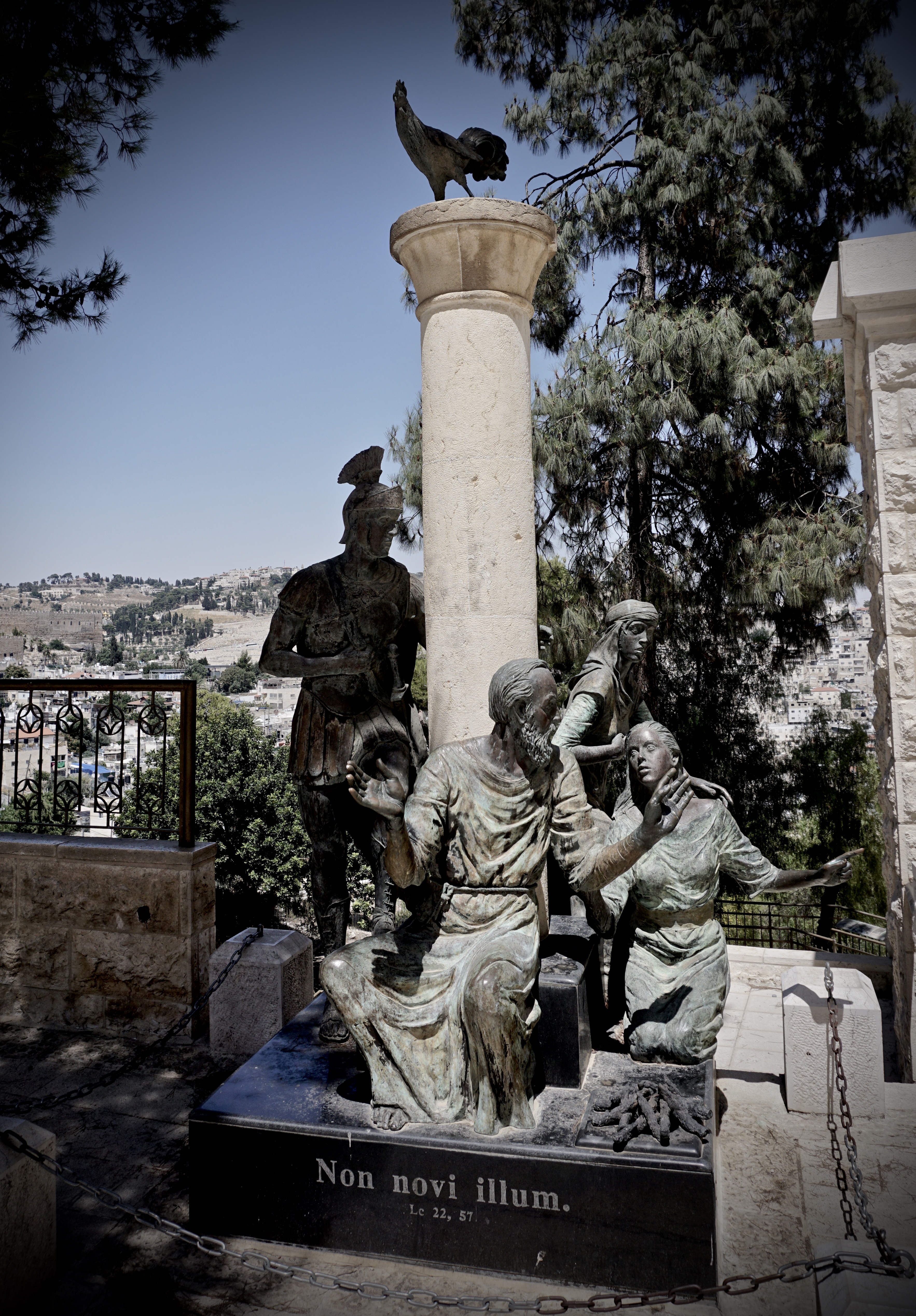
As I made my way back up out of the pit, I stepped out into a courtyard and was met with a statue depicting the biblical narrative from which that particular church gets its name. Gallicantu comes from a Latin word that translates to “where the rooster has crowed.”
Scripture tells us that as Jesus was arrested and taken to Caiaphas’ house, Peter—arguably the most well-known disciple of Jesus—followed behind and entered into the courtyard of the high priest. While he was there, he was recognized 3 times as being a follower of Jesus—and 3 times he vehemently denied it.
“Then seizing him, they led him away and took him into the house of the high priest. Peter followed at a distance. And when some there had kindled a fire in the middle of the courtyard and had sat down together, Peter sat down with them. A servant girl saw him seated there in the fire light. She looked closely at him and said, ‘This man was with him.’
But he denied it. ‘Woman, I don’t know him,’ he said.
A little later someone else saw him and said, ‘you also are one of them.’
‘Man, I am not!’ Peter replied.
About an hour later another asserted, ‘Certainly this fellow was with him, for he is a Galilean.’
Peter replied, ‘Man, I don’t know what you’re talking about!’ Just as he was speaking, the rooster crowed. The Lord turned and looked straight at Peter. Then Peter remembered the word the Lord had spoken to him: ‘Before the rooster crows today, you will disown me three times.’ And he went outside and wept bitterly.” (Luke 22:54-62)
It is one thing to sit in the pit and identify with Jesus in His sufferings. It’s another thing altogether to identify with Peter in this moment.
- This is the same Peter who just earlier that very evening had sworn to Jesus that he was ready to follow Him to prison and to death (Luke 22:33)
- This is the same Peter who just earlier that evening had the (misplaced) courage to cut the ear off one of the men who came to arrest Jesus (John 18:10)
Peter was passionate, zealous, and (oftentimes overly) confident. There is no doubt that he loved Jesus dearly—and indeed Peter was part of Jesus’ “inner circle” along with James and John the sons of Zebedee. Yet in the darkness of this moment, when the idea of following Jesus to prison and to death became more of a tangible reality, Peter’s courage failed and he denied his Lord.
I don’t know about you, but it is all too easy for me to relate to Peter in this moment. I can remember well my own moments of hubris and pride, imagining the great and courageous things I would do for the sake of the Kingdom—and also the moments when my faith crumbled under the weight of fear.
In his book Absolute Surrender, Andrew Murray reflects on Peter’s denial of Christ:
…with what self-confidence Peter said: ‘Though all should forsake thee, yet will not I. I am ready to go with thee, to prison and to death.’
Peter meant it honestly, and Peter really intended to do it; but Peter did not know himself. He did not believe he was as bad as Jesus said he was.
In being faced with the reality of his denial, Peter came to the end of himself. Those who know Scripture know the next chapter for Peter—but in this moment he himself did not. Peter denies his Lord, Jesus dies on the cross and is buried. And for the next 3 days—as far as Peter is concerned—that is the end of the story.
Imagine the weight of grief and shame that Peter must have felt in that moment. Not only is his Lord dead, but in His moment of need Peter severed all connection with Him—denying that he even knew Him. The last look he shared with his Lord and Master was in a moment of weakness, betrayal and shame.
During the following hours of that night, and the next day, when he saw Christ crucified and buried, and the next day, the Sabbath—oh, in what hopeless despair and shame he must have spent that day!
‘My Lord is gone, my hope is gone, and I denied my Lord. After that life of love, after that blessed fellowship of three years, I denied my Lord. God have mercy upon me!’
Absolute Surrender by Andrew Murray
Just as we may be too quick to move past the sufferings of Christ to get to the resurrection, so too we may be too quick to move past Peter’s denial to get to his restoration.
And might that tendency lead us to react in similar ways to our own suffering and sin?
As we identify with Christ in His sufferings, we are reminded that we too will suffer in this life. And like Christ did, we can endure our suffering with patience and hope—for we know that it is not the end of the story, and resurrection is coming.
As we identify with Peter in his grief and shame, we are reminded of the weight of our own sin and the ways we deny Christ. And like Peter, we can weep bitterly in the repentance that leads to restoration.
Without death there is no resurrection. And without sorrow and grief there is no true repentance. So this Holy Week may we not pass over too quickly the pain of these days in our desire to reach the joy of Sunday. May we reflect on the sufferings of Christ and pray that God would equip us to bear our own sufferings with such patience and grace. And may we reflect on the sorrow of Peter, and invite the Spirit to allow us to feel the weight of our own sin and shame. And may we do it all with unshakable hope, because make no mistake—Sunday is coming.
 Paramutheomai