
I remember the first time that it hit me—breathing in the cold winter air in the parking garage of the hospital where I was completing my chaplaincy internship. I was in my final semester of Seminary, and was just starting to seriously consider what the next step might be. The previous year I had settled on the what but now the where was starting to become an area of focus. I realized that I would be attempting to break into an entirely new career, one in which I had virtually no experience and little to no concrete understanding of what I would even be doing. As I sent out those first few job applications, I received a piece of advice that was very helpful and also felt like a punch in the gut: If this was what I really wanted to do—if I wanted to break into this new field—I would have to open myself up to going wherever I could find an opportunity.
This hit me hard, because I absolutely loved living in Denver and the thought of leaving made me sick to my stomach. I had spent 5 years building a home and a community there, and I was just starting to settle into a new church family where I felt more at home than ever before. But as the doors to opportunities in Denver started to close, I was hit with the heartbreaking realization that I would have to make a choice: I could choose to stay in the city that I loved, or I could choose to pursue the work I felt God calling me to. I couldn’t have both.
I cried for the next 3 weeks.
I had a choice to make, but I knew in my heart that there wasn’t really a choice. So I started to pray, “God, please help me to be open to wherever you might call me next (even if it’s back to Minnesota).”
But even with that prayer of surrender, God didn’t reveal the path to me right away—in fact He kept me waiting on pins and needles. Over the course of the summer after my graduation, I applied to over 60 positions in 24 different states—ready to pack up and move at a moment’s notice. After months, those 60+ applications had only yielded 4 phone interviews—leaving me frustrated and discouraged. Just being willing to move had felt like climbing a mountain, and now here I was—ready to leave it all behind to go where I believed God was calling me—but I felt more stuck than ever.
I finally reached a point where felt it seemed that every door had been closed, and I accepted a position as an Academic Advisor in Denver—a good job, but not the one I had been looking for. While it wasn’t the job I wanted, it meant that I could stay in Colorado; I wouldn’t have to say goodbye just yet. So I breathed a sigh of relief and started to settle back in—confident I’d have at least another year in the place I loved.
But just a few weeks after starting my new job, one of the doors that I had assumed was shut after weeks of radio silence suddenly swung wide open. As soon as I received the call, I knew: this was it. I felt like my entire world was being turned upside down in a moment, and I walked through the next few weeks in a daze. It felt like the ground kept shifting beneath me: as soon as I thought I knew where my life was headed, something would change.
There’s a song that formed the soundtrack for my life in that season, and I remember singing it out in faith on my morning commute during those weeks of uncertainty:
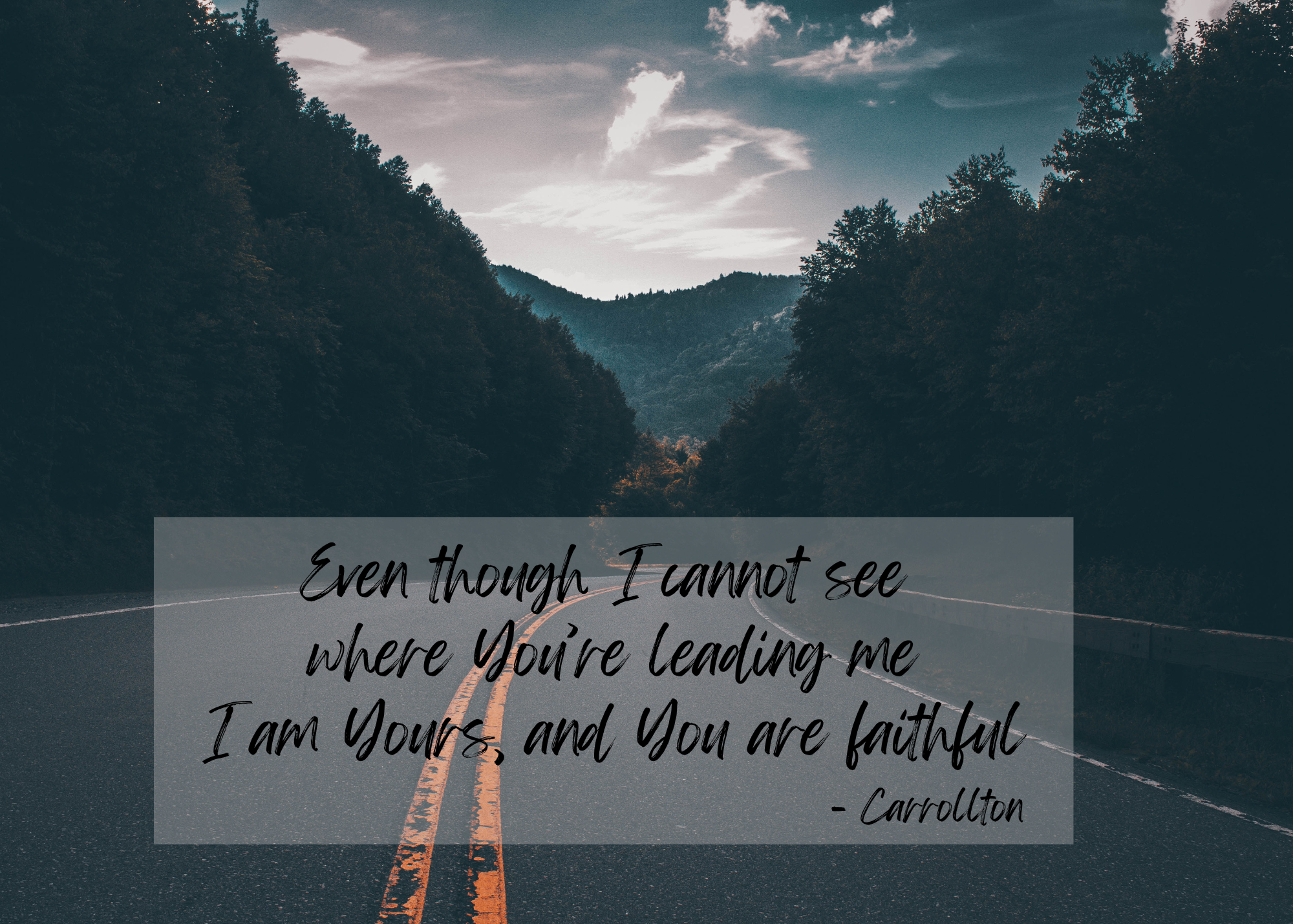
Even though I cannot see where you’re leading me // I am Yours, and You are faithful.
Carrollton
About a month after I received that call, I was packed up and ready to head to my new home—in Minnesota of all places. And on an icy cold November morning I wept as I hugged my roommates goodbye and drove away from a house that had become a home, in a place that I loved with people that I loved. Less than 2 years after that, I found myself uprooting my life once again to complete the journey East—this time to move to Massachusetts—to start a new job, at a new school, in a place where I didn’t know anyone, in the middle of a global pandemic.

Over 10 years ago I made my Journey West, where I learned that we have a sovereign God whose plans and purposes prevail. While it felt like an eternity at the time, I didn’t have to wait long to begin to see the work God wanted to accomplish in my life during that season—perhaps in part because that work was dramatic and life-changing. My 5 years in Denver were a fruitful time of growth, change, and new experiences. In fact, I often find myself longing for a return to those days—to days when I felt like I could see God working everywhere I looked, and I could spend hour upon hour reflecting and writing about what God was doing in my life. Don’t get me wrong, there were challenges and painful circumstances, but it was such a sweet season of my life that I’ll forever be grateful for.
As I write this, it is 5 years to the day since I began my progressive Journey East—full of expectation for what this next season of life would hold. But if I’m really honest, the years since then have not looked the way I expected. Those years have held a lot of blessings, but they have also held unexpected challenges; multiple transitions in location and the loneliness that can accompany that—compounded by a global pandemic that turned life upside-down for a number of years. They have held many losses; the passing of loved ones, the loss of valued friendships, and the nagging grief of unmet desires and unfulfilled dreams.
Perhaps it’s too much honesty to say that my life does not look the way I once hoped it would. Perhaps it’s too much honesty to say that the life I’m living right now is not the life I would have chosen for myself.
For the past 5 years I have been working closely with college students—over 3 of those years in the Christian college context. One of the great honors of my life is the privilege to walk alongside these students at such a pivotal time, as they make decisions that will chart the trajectories of their lives. I often see in them an immense pressure to have a plan for what their life is going to look like; to set goals and to be laser focused on bringing that plan into fruition. But one of the questions I often encourage my students to consider is this: What if the life you would choose for yourself is different from the life God has for you?
As you might imagine, that question is often met with squirming, hedging, or outright avoidance. And I get it—it’s not a comfortable question to consider. But through many tears I have come to believe that it is of essential importance, because it forces us to confront a deeper question; do we serve a God who can be trusted with our surrender? It’s the question I faced on that icy cold morning in a hospital parking garage, as I wrestled with the call to surrender my physical location and all the things that accompanied it and to go wherever God would lead.
So I’ll ask again; is it too much honesty to say that the life I’m living right now is not the life I would have chosen for myself? It’s a statement that feels inherently negative, but that’s only when viewed through the lens of this world—a lens predicated on the belief that ultimately we know what’s best for us, that we know best how to steer the ships of our lives to the sweetest harbors.
When God reveals Himself to Moses in Exodus 34:5-7, He reveals Himself as a God who is “merciful and gracious, slow to anger, and abounding in steadfast love and faithfulness” (v. 6, ESV). The Hebrew word translated steadfast love is chesed (or hesed); a word that appears throughout Scripture in affirmations of—and appeals to—the steadfast and faithful love that is foundational to who God has revealed Himself to be. In his book “When the Stars Disappear: Help and Hope from Stories of Suffering in Scripture” Mark Talbot writes,
“…so for God to declare that he abounds in chesed means that it is his character to be always overflowing in great quantities of steadfast love and faithfulness to his people, no matter how it may seem” (p. 69)
And nowhere is the incredible love of God on display more clearly than in the sending of His son Jesus to be the atoning sacrifice for our sins, that we might be brought from death to life and spend all of eternity with Him.
“In this is love, not that we have loved God but that he loved us and sent his Son to be the propitiation for our sins.”
1 John 4:10, ESV
“What then are we to say about these things? If God is for us, who is against us? He did not even spare his own Son but gave him up for us all. How will he not also with him grant us everything?”
Romans 8:31-32, CSB
In this season, I’ve been learning that one of the beautiful things that God calls us to—when He calls us to Himself—is to surrender. I believe this surrender is beautiful, because He calls us to place our lives in hands much more competent than our own. When we entrust our lives to God in surrender, we entrust them to One who has not only the wisdom to know what is best for us, but also the power to carry it out. When we trust God with our lives, we trust in a Wisdom that far surpasses our own and a Goodness and Love that exceeds anything we could ever comprehend. If God really is is who He says He is, then His plans for our lives are infinitely better than the best we could ever dream up for ourselves. So it is with great JOY and HOPE that we can prefer the life God has for us over the lives we might otherwise choose for ourselves.
The life I’m living is not the life I would have chosen for myself; it is so much more. That’s a bold statement to make. It’s a statement that requires us to hold in tension the “already and not yet” of the Christian faith. The life I’m living is full of moments of immense gratitude when I see pieces of God’s plan unfolding in ways that surpass my every dream and desire—yet at the same time it still holds difficulties, pain, and disappointment. One of the challenges that we must face as we affirm the chesed of God is that, at least on the surface, our lives in this sinful and broken world often seem to contradict it. We may find ourselves asking: If God will grant us everything, why do we still feel the ache of so many unmet desires? If God is for us, why do we not see Him step into our circumstances in the ways that we might hope? It is in those moments that we must cling in hope to the truth of who He has revealed Himself to be.
“Biblical faith and hope are grounded in God’s self-revelation that—no matter how dark and hopeless life may now seem—his saints will ultimately know him as ‘the God of chesed,’ for that is indeed his name.”
When the Stars Disappear, p. 82
When I embarked on this journey east 5 long years ago, I didn’t really have the slightest clue where God was leading me. And in many ways, I still don’t. In the moments when I lose sight of the larger story that is at work, it can be easy to grow discouraged with a life that doesn’t look the way I might have once hoped. But the stories of God’s people recorded in Scripture affirm for us again and again that:
“What appears at some point to be the story of a life may not be what the full story of that life actually and finally is. God was still working for their good”
When the Stars Disappear, p. 84
And God is still working for our good. What that “good” will ultimately look like, we may not know or even get to see this side of eternity. But we have a God who can be trusted with our surrender; for His steadfast love never ceases and His mercies never come to an end—they are new every morning. Great is His faithfulness! (Lamentations 3:22-23)
 Paramutheomai
One thought on “Lessons Learned from a Journey East”