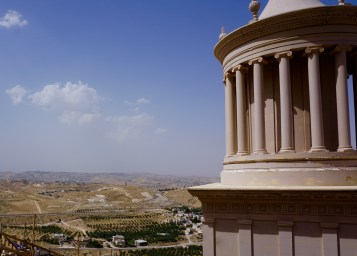
 A few years ago I had the amazing opportunity to spend three weeks exploring the land of Israel. If I had to sum up the trip in a sentence, it would be: ROCKS, ROCKS, and more ROCKS. We spent a large portion of our time visiting the ruins of ancient biblical sites like Jericho, Megiddo, and Hazor. Each day of field study was given a theme by the leaders of our trip that would help to guide our thinking for the day. One day in particular, the theme—drawn from the lyrics of an old hymn—really stuck with me: “Oh where are kings and empires now.” In many ways, I felt like that could have been the theme for the whole trip.
Perhaps one of the most striking moments in this regard came during our visit to the Herodium. Herod the Great was a puppet king, which meant that he could not make a name for himself in the way that other kings did—by going to war. So instead, he made a name for himself through his monumental building projects: the “Second Temple,” Masada, Caesarea, and the Herodium—just to name a few. The Herodium was a monumental fortress that loomed high over the region of Judea, an imposing presence for those living in the vast land around it. It was also the location where Herod intended his tomb to be, and he even created a long strip of road for his funeral procession. Josephus records that Herod the Great went so far as to instruct his soldiers to murder a large number of notable Jews on the day of his death in order to ensure that there would be mourning throughout the land, and not celebration.
As we stood in the ruins of where it is believed that Herod’s mausoleum once stood, our professor pointed across the plain to the mountains on the horizon—to the location of Bethlehem. While Herod was building his kingdom one monumental structure at a time, another King was being born in a humble town in the shadow of Herod’s fortress.
Herod—known for being extremely paranoid—took every measure possible to try to ensure that his kingdom would not be stripped away from him, including murdering all the male babies in Bethlehem (not to mention many of his own sons). But in spite of all his efforts, Herod’s kingdom ended up in the rubble and ruin that we explored on our trip. And we see the same story repeated again and again throughout human history—empires rise and fall, governments are established and they crumble.
But the New Testament tells a different story about a different kind of kingdom operating on a very different principle—a Kingdom that endures forever. It is a kingdom not built of bricks and stones, but of human hearts and lives. It is a kingdom not established by greed and violence, but by the sacrifice of a very different kind of King.
While Herod the Great clung to his power at all costs, Jesus willingly surrendered the power that was (and is) rightfully his. The Apostle Paul writes in his letter to the church in Philippi that Jesus,
“who, being in very nature God, did not consider equality with God something to be used to his own advantage; rather, he made himself nothing by taking the very nature of a servant, being made in human likeness. And being found in appearance as a man, he humbled himself by becoming obedient to death—even death on a cross!” (Philippians 2:6-8, NIV)
The humility of Jesus stands in such stark contrast to the ways of this world—and the call of His followers is counter-cultural as well. In the verses preceding the passage above, Paul writes to followers of Jesus in Philippi:
“Do nothing out of selfish ambition or vain conceit. Rather, in humility value others above yourselves, not looking to your own interests but each of you to the interests of others. In your relationships with one another, have the same mindset as Christ Jesus…” (Philippians 2:3-5).
Following Jesus is not about praying a prayer and getting a “golden ticket to heaven” when you die; it is a call to trust in Jesus and to follow in the steps of His life, death, and resurrection. We die to the things this world tells us to pursue—pride, status, wealth, power—and live a life of humility and love modeled after our Savior. We abandon our misplaced hope in worldly kingdoms, and rather seek His Kingdom.
Here in the United States of America, we have been living in a time of great uncertainty—along with the rest of the world. Pandemic has stripped away our sense of control and stability, as many have faced the loss of their livelihood, the things they enjoy, their health, and even their very lives. And as if the COVID-19 pandemic has not destabilized us enough, add to that the immense political tensions and the recent experience of an incredibly tumultuous presidential election cycle. Fear is running rampant in the media, on social media, and even in our churches. In the months leading up to the election it became pretty clear that whatever the outcome of the election, about half of the American population believed our democracy was at risk of collapse—and about a year later, many continue to live in that fear.
These things are not unimportant. While it certainly has its flaws—like any human government—I do believe that our democracy is a system of human government that has provided a lot of opportunity for the flourishing of humankind. I am grateful and consider myself blessed that I get to live here, and I pray that God will continue to bless and protect this country. But if history has taught us anything it’s that empires rise and fall; governments are established and they crumble.
The reality is, should this world endure long enough to see it, our American democracy will someday collapse. Any worldly endeavor involving fallen humanity is subject to corruption and decay, and will someday find itself in ruins, just like the monumental buildings of king Herod. Should the world endure another 2000+ years, can we imagine curious humans exploring the ruins of our cities, institutions, and monuments—telling the stories of our rise and fall?
Maybe this all sounds a little fatalistic and despairing. But those who follow Christ have hope, because we know that while governments are established and they crumble, God is sovereign over it all. And our hope is not in human governments or institutions that are subject to corruption and decay, but in the “already and not yet” of God’s heavenly Kingdom.
Last Christmas season, amidst a time of political and racial tension, I invited my RA staff and my residents to reflect on a well known passage from the book of Isaiah:
“For to us a child is born,
to us a son is given,
and the government will be on his shoulders.
And he will be called
Wonderful Counselor, Mighty God,
Everlasting Father, Prince of Peace.
Of the greatness of his government and peace
there will be no end.” (Isaiah 9:6-7a)
In the book of Daniel we are told that God will establish a kingdom that will never be destroyed, and that will bring an end to all other kingdoms (Daniel 2:44). This promise is found throughout Scripture—this looking ahead to the inauguration of the Kingdom of God. We look forward with anticipation to the final establishment of this Kingdom that will not be subject to corruption and decay, because it will not be ruled by fallen and sinful humans but by our Holy God.
The writer of Hebrews tells of the “heroes of faith,” ultimately concluding that they were not seeking a worldly home but a heavenly one:
“These all died in faith, not having received the things promised, but having seen them and greeted them from afar, and having acknowledged that they were strangers and exiles on the earth. For people who speak thus make it clear that they are seeking a homeland. If they had been thinking of that land from which they had gone out, they would have had the opportunity to return. But as it is, they desire a better country, that is, a heavenly one.” (Hebrews 11:13-16a)
But what do our lives reflect? Which kingdom do they seek to build? Are we like Herod, keeping a tight grip on our power and wealth, wary of anyone who would threaten to take what belongs to us? Or are we like Jesus, willing to be emptied of ourselves for the sake of others, living in open-handed humility with our eyes fixed on the hope of eternity in the Kingdom of God? As Paul writes in the first letter to the Corinthians:
“If only for this life we have hope in Christ, we are of all people most to be pitied.” (1 Corinthians 15:19)
I am confronted with my own “Herodian” tendencies on a near daily basis. I see it when someone else is given the recognition that I think I deserve, and I grow angry or my attitude turns sour. I see it when someone “takes me down a peg” (intentionally or unintentionally) and I feel myself bristle and want to lash out. I see it in those moments when reading the news makes me want to curl up in a hole and hide—fearful of what is to come and what losses I might face. But when those moments happen, I have been learning to recognize them as opportunities to die to myself, to die to the world, and to take even one little step toward the life of humility and hope to which I am called as a follower of Christ. I know, that may seem strange—a little too stoic or ascetic. But those rocks in Israel will always remind me that the kingdoms of this world are ultimately futile efforts that will end in ruin and rubble—they are no place to rest my hope.
“Do not lay up for yourselves treasures on earth, where moth and rust destroy and where thieves break in and steal, but lay up for yourselves treasures in heaven, where neither moth nor rust destroys and where thieves do not break in and steal” (Matt. 6:19-20).
So I think the question we are left with is this: where do our allegiances lie? Where is our true citizenship? Is it in this earthly kingdom—a land of “freedom and prosperity”—or is it in the Kingdom of Heaven? I believe that I am blessed to have been born in this country, to have enjoyed the safety, freedom, and opportunity that it offers. But like many things in this world, that blessing quickly becomes a curse if I allow it to become an idol; if I become more committed to my rights and my “way of life” than to the gospel of Jesus Christ. So when we see the signs of decay in the world around us may we seek the good of the place where we find ourselves (Jeremiah 29:7), but also let it remind us that this world is not our true home. Let it point our hearts to the hope that we have in Christ—a hope that is sure and enduring, and which cannot be shaken.
 Paramutheomai